General Requirement Solve Hand Try Solve Without Using Compiler Q43894676
General requirement is to solve by hand and try tosolve without using a compiler.
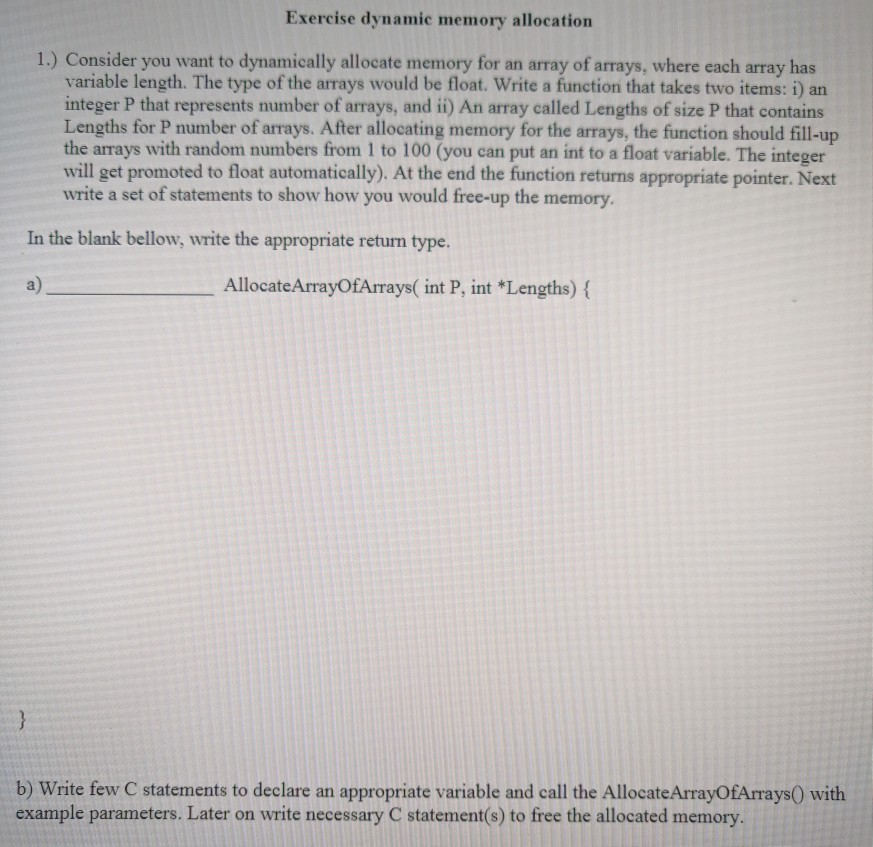
Exercise dynamic memory allocation 1.) Consider you want to dynamically allocate memory for an array of arrays, where each array has variable length. The type of the arrays would be float. Write a function that takes two items: i) an integer P that represents number of arrays, and ii) An array called Lengths of size P that contains Lengths for P number of arrays. After allocating memory for the arrays, the function should fill-up the arrays with random numbers from 1 to 100 (you can put an int to a float variable. The integer will get promoted to float automatically). At the end the function returns appropriate pointer. Next write a set of statements to show how you would free-up the memory. In the blank bellow, write the appropriate return type. AllocateArrayOfArrays( int P, int *Lengths) { b) Write few C statements to declare an appropriate variable and call the AllocateArrayOfArrays() with example parameters. Later on write necessary C statement(s) to free the allocated memory. Show transcribed image text Exercise dynamic memory allocation 1.) Consider you want to dynamically allocate memory for an array of arrays, where each array has variable length. The type of the arrays would be float. Write a function that takes two items: i) an integer P that represents number of arrays, and ii) An array called Lengths of size P that contains Lengths for P number of arrays. After allocating memory for the arrays, the function should fill-up the arrays with random numbers from 1 to 100 (you can put an int to a float variable. The integer will get promoted to float automatically). At the end the function returns appropriate pointer. Next write a set of statements to show how you would free-up the memory. In the blank bellow, write the appropriate return type. AllocateArrayOfArrays( int P, int *Lengths) { b) Write few C statements to declare an appropriate variable and call the AllocateArrayOfArrays() with example parameters. Later on write necessary C statement(s) to free the allocated memory.
Expert Answer
Answer to General requirement is to solve by hand and try to solve without using a compiler….
OR