(Solved) : Payload Deflection Data Obtained Function Time Tower Crane Excel Data File Cranedataxlsx U Q26340401 . . .
Payload deflection data was obtained as a function of time for aTower Crane. The Excel data file (craneData.xlsx) has been uploadedto the T-square site and is automatically imported into theprovided MATLAB project script if it is placed in the samedirectory as the script.
The free response of the tower crane payload deflection could bemodeled by a damped sine function, such as
y(t) =Ceλ(t−t0)cos(ω(t – t0) + ) +B (1)
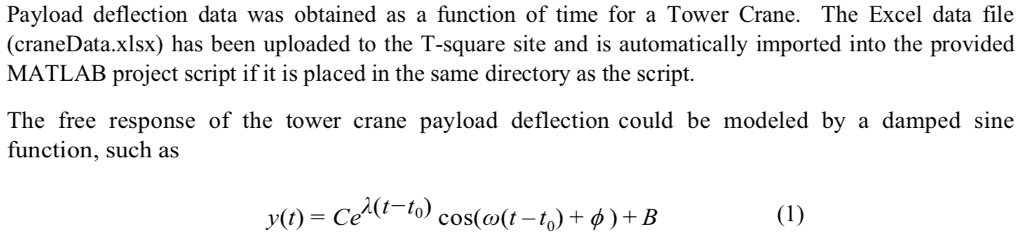
where: C = initial amplitude, λ = exponentialdecay constant, ω = frequency, t0 = time offset, = phase
angle at t = t0, and B = deflectionmeasurement offset, or bias
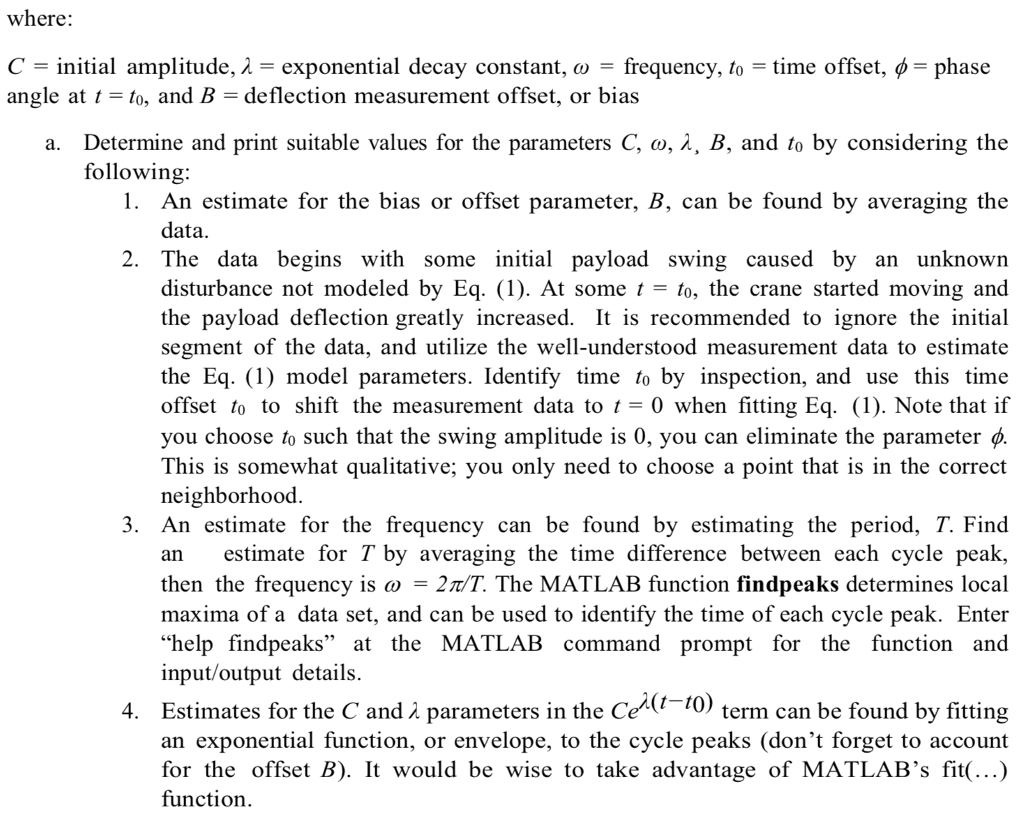
a. Determine and print suitable values for the parametersC, ω, λ ̧ B, and t0 byconsidering the following:
An estimate for the bias or offset parameter, B, can befound by averaging the data.
The data begins with some initial payload swing caused by anunknown disturbance not modeled by Eq. (1). At some t =t0, the crane started moving and the payload deflectiongreatly increased. It is recommended to ignore the initial segmentof the data, and utilize the well-understood measurement data toestimate the Eq. (1) model parameters. Identify time t0 byinspection, and use this time offset t0 to shift themeasurement data to t = 0 when fitting Eq. (1). Note thatif you choose t0 such that the swing amplitude is 0, youcan eliminate the parameter . This is somewhat qualitative; youonly need to choose a point that is in the correctneighborhood.
An estimate for the frequency can be found by estimating theperiod, T. Find
an estimate for T by averaging the time differencebetween each cycle peak, then the frequency is =2/T. The MATLAB function findpeaksdetermines local maxima of a data set, and can be used to identifythe time of each cycle peak. Enter “help findpeaks” at the MATLABcommand prompt for the function and input/output details.
4. Estimates for the C and λ parameters in theCeλ(t−t0) term can befound by fitting an exponential function, or envelope, to the cyclepeaks (don’t forget to account for the offset B). It wouldbe wise to take advantage of MATLAB’s fit(…) function.
Use the MATLAB function Function.m attached below:
%Start Code
close all;
craneData = xlsread(‘craneData.xlsx’);
figure(2);
hold on;
plot(craneData(:,1),craneData(:,2));
xlabel(‘Time (s)’); ylabel(‘Deflection’);
title(‘Provided Crane Data’);
% Find bias parameter
%***CODE GOES HERE***
% Find time offset by inspection; resize and shift dataarray
%***INSERT VALUE FOR t0 HERE***
t0 = 0;
i = find(craneData(:,1) == t0);
craneData_t0 = craneData(i:end,:);
craneData_t0(:,1) = craneData_t0(:,1) – t0;
% Find peaks in data
%***CODE GOES HERE***
% Estimate the period and frequency
%***CODE GOES HERE***
% Fit exponential
%***CODE GOES HERE***
% Print Parameters
%***CODE GOES HERE***
% Generate plot
%***CODE GOES HERE***
%End Code
Data Set (rename to Crane Data.xlsx before use) can be found athttps:// anonfile . com/X6Y913d1b7/Crane_Data.xlsx
Payload deflection data was obtained as a function of time for a Tower Crane. The Excel data file (craneData.xlsx) has been uploaded to the T-square site and is automatically imported into the provided MATLAB project script if it is placed in the same directory as the script The free response of the tower crane payload deflection could be modeled by a damped sine function, such as y(t) = Ce Show transcribed image text
Expert Answer
Answer to Payload Deflection Data Obtained Function Time Tower Crane Excel Data File Cranedataxlsx U Q26340401 . . .
OR