(Solved) : Incorrect Question 2 0 1 Pts 01 Int F Int N 02 N 1 03 Return 1 Line 04 Return N F N 1 05 0 Q43925716 . . .
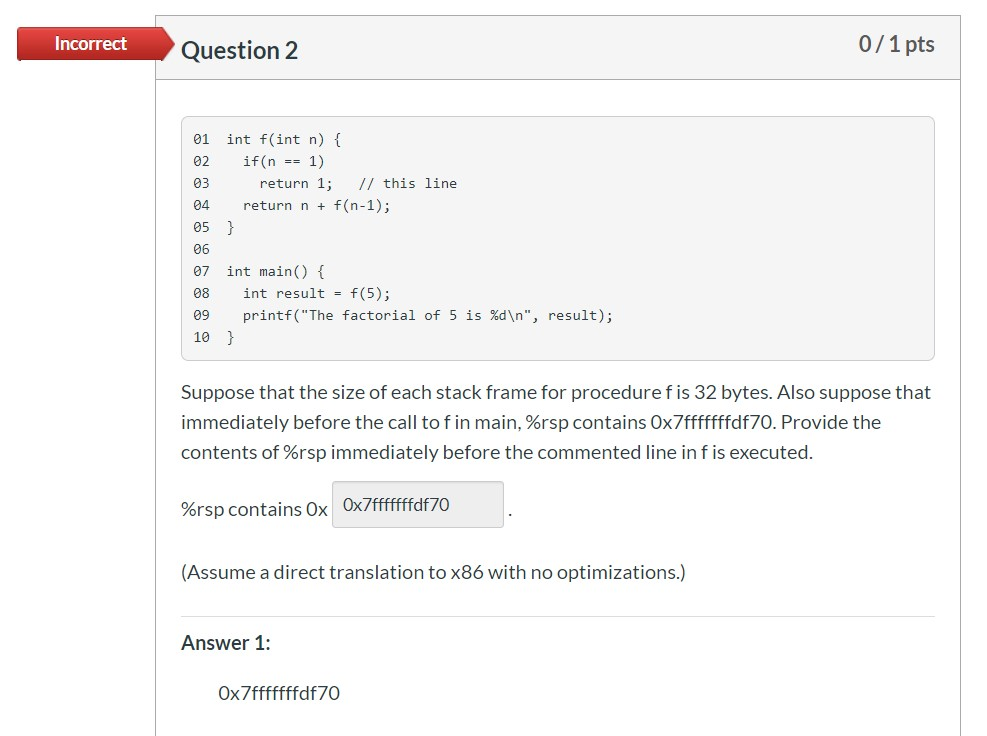
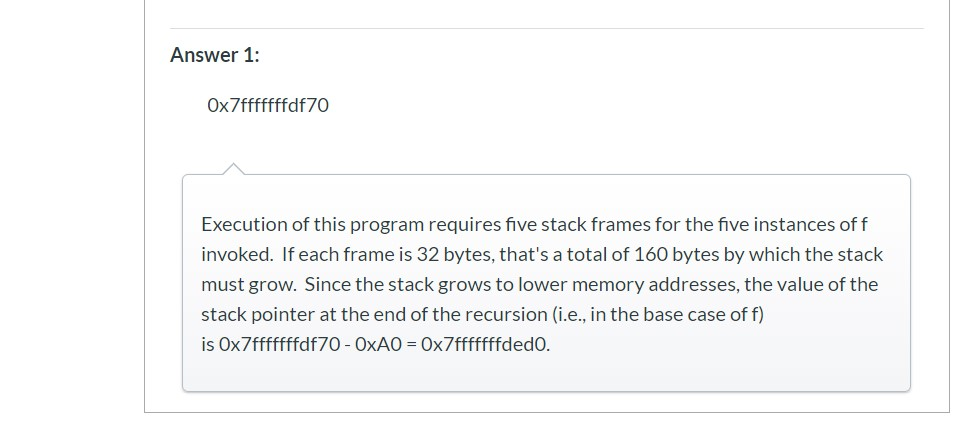
Incorrect Question 2 0/1 pts 01 int f(int n) { 02 if(n == 1) 03 return 1; // this line 04 return n + f(n-1); 05 } 07 08 09 10 int main() { int result = f(5); printf(“The factorial of 5 is %dn”, result); } Suppose that the size of each stack frame for procedure fis 32 bytes. Also suppose that immediately before the call to fin main, %rsp contains Ox7fffffffdf70. Provide the contents of %rsp immediately before the commented line infis executed. %rsp contains Ox Ox7fffffffdf70 (Assume a direct translation to x86 with no optimizations.) Answer 1: Ox7fffffffdf70 Answer 1: Ox7fffffffdf70 Execution of this program requires five stack frames for the five instances off invoked. If each frame is 32 bytes, that’s a total of 160 bytes by which the stack must grow. Since the stack grows to lower memory addresses, the value of the stack pointer at the end of the recursion (i.e., in the base case of f) is Ox7fffffffdf70 – OxAO = 0x7fffffffdedo. Show transcribed image text Incorrect Question 2 0/1 pts 01 int f(int n) { 02 if(n == 1) 03 return 1; // this line 04 return n + f(n-1); 05 } 07 08 09 10 int main() { int result = f(5); printf(“The factorial of 5 is %dn”, result); } Suppose that the size of each stack frame for procedure fis 32 bytes. Also suppose that immediately before the call to fin main, %rsp contains Ox7fffffffdf70. Provide the contents of %rsp immediately before the commented line infis executed. %rsp contains Ox Ox7fffffffdf70 (Assume a direct translation to x86 with no optimizations.) Answer 1: Ox7fffffffdf70
Answer 1: Ox7fffffffdf70 Execution of this program requires five stack frames for the five instances off invoked. If each frame is 32 bytes, that’s a total of 160 bytes by which the stack must grow. Since the stack grows to lower memory addresses, the value of the stack pointer at the end of the recursion (i.e., in the base case of f) is Ox7fffffffdf70 – OxAO = 0x7fffffffdedo.
Expert Answer
Answer to Incorrect Question 2 0/1 pts 01 int f(int n) { 02 if(n == 1) 03 return 1; // this line 04 return n + f(n-1); 05 } 07 08 …
OR