(Solved) : Include Harvesting Factor E B F E Var B F E Rb 05 Kb 150000 Rf 08 Kf 400000 Gb Rb B 1 B Kb Q43914783 . . .
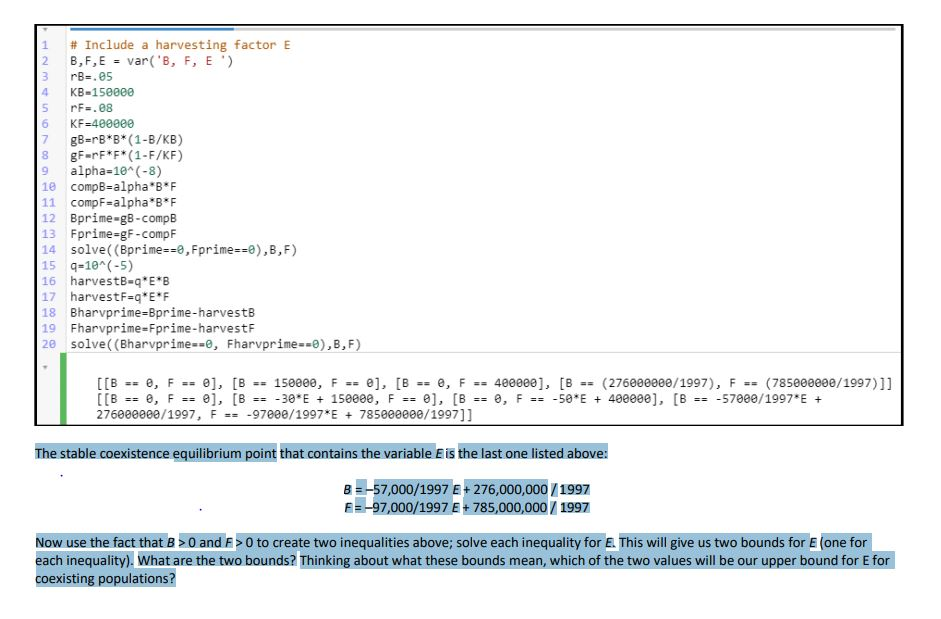
# Include a harvesting factor E B,F,E = var(‘B, F, E ‘) rB=.05 KB-150000 rF=.08 KF=400000 gB=rB*B* (1-B/KB) gF-rF*F* (1-F/KF) alpha-10^(-8) 10 compB=alpha*B*F 11 compF=alpha*B*F 12 Bprime-gB-compB 13 Fprime-gF-compF 14 solve( (Bprime==0, Fprime==0),B,F) 15 q-10^(-5) 16 harvestB-q*E*B 17 harvestF=q*E*F 18 Bharvprime=Bprime-harvestB 19 Fharvprime-Fprime-harvestF 20 solve( (Bharvprime–0, Fharvprime–0),B,F) [[B =- 0, F == 0], [B [[B 276000000/1997, F == 150000, F — e], [B == e, F == 4еeeee], [в e], [B == 0, F == -50*E + 400000), [B (276000000/1997), F == (785000000/1997)]] -57000/1997*E + e, F == e], [B -зе*Е + 150еге, F %33 =3= -97008/1997*E + 7850e0008/1997]] The stable coexistence equilibrium point that contains the variable Eis the last one listed above: B=-57,000/1997 E+ 276,000,000 / 1997 E=-97,000/1997 E + 785,000,000 / 1997 Now use the fact that B > 0 and F>0 to create two inequalities above; solve each inequality for E. This will give us two bounds for E (one for each inequality). What are the two bounds? Thinking about what these bounds mean, which of the two values will be our upper bound for E for coexisting populations? Show transcribed image text # Include a harvesting factor E B,F,E = var(‘B, F, E ‘) rB=.05 KB-150000 rF=.08 KF=400000 gB=rB*B* (1-B/KB) gF-rF*F* (1-F/KF) alpha-10^(-8) 10 compB=alpha*B*F 11 compF=alpha*B*F 12 Bprime-gB-compB 13 Fprime-gF-compF 14 solve( (Bprime==0, Fprime==0),B,F) 15 q-10^(-5) 16 harvestB-q*E*B 17 harvestF=q*E*F 18 Bharvprime=Bprime-harvestB 19 Fharvprime-Fprime-harvestF 20 solve( (Bharvprime–0, Fharvprime–0),B,F) [[B =- 0, F == 0], [B [[B 276000000/1997, F == 150000, F — e], [B == e, F == 4еeeee], [в e], [B == 0, F == -50*E + 400000), [B (276000000/1997), F == (785000000/1997)]] -57000/1997*E + e, F == e], [B -зе*Е + 150еге, F %33 =3= -97008/1997*E + 7850e0008/1997]] The stable coexistence equilibrium point that contains the variable Eis the last one listed above: B=-57,000/1997 E+ 276,000,000 / 1997 E=-97,000/1997 E + 785,000,000 / 1997 Now use the fact that B > 0 and F>0 to create two inequalities above; solve each inequality for E. This will give us two bounds for E (one for each inequality). What are the two bounds? Thinking about what these bounds mean, which of the two values will be our upper bound for E for coexisting populations?
Expert Answer
Answer to # Include a harvesting factor E B,F,E = var(‘B, F, E ‘) rB=.05 KB-150000 rF=.08 KF=400000 gB=rB*B* (1-B/KB) gF-rF*F* (1-…
OR