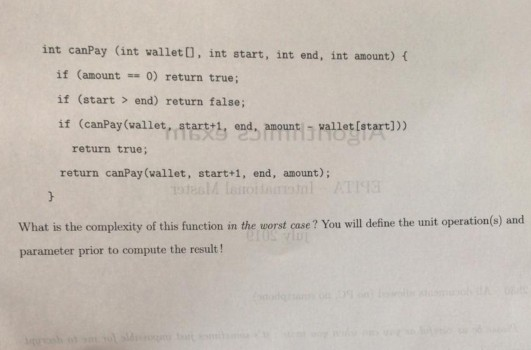
Int Canpay Int Wallet Int Start Int End Int Amount Amount 0 Return True Start End Return F Q43790892
Advanced Algorithm: Complexity in the worst case
int canPay (int wallet), int start, int end, int amount) { if (amount == 0) return true; if (start > end) return false; if (canPay(wallet, start+1, end, amount-vallet[start] return true; return canPay (wallet, start+1, end, amount); What is the complexity of this function in the worst case? You will define the unit operation(s) and parameter prior to compute the result! Show transcribed image text int canPay (int wallet), int start, int end, int amount) { if (amount == 0) return true; if (start > end) return false; if (canPay(wallet, start+1, end, amount-vallet[start] return true; return canPay (wallet, start+1, end, amount); What is the complexity of this function in the worst case? You will define the unit operation(s) and parameter prior to compute the result!
Expert Answer
Answer to int canPay (int wallet), int start, int end, int amount) { if (amount == 0) return true; if (start > end) return false; …
OR